L
o
a
d
i
n
g
.
.
.
1. Invalid Alarm Types
1.1 Repeated Alarms
Repeated alarms are defined as alarms that trigger and clear more than three times per minute for analytical judgment. Such alarms distract operators and interfere with normal operations.
Causes of repeated alarms include on-site instrument faults, poor control performance, unreasonable alarm setpoints, or improperly configured dead bands and delay times.
Improvement solutions for repeated alarms include but are not limited to:
◆ Set a reasonable dead band range
◆ Add alarm trigger delay (TON) or alarm reset delay (TOF)
◆ Apply PV value filtering
◆ Adjust alarm setpoints
Technical discussions have been held with plant operation personnel. Specific alarm reduction recommendations are listed below (transient flash alarms have already been eliminated).
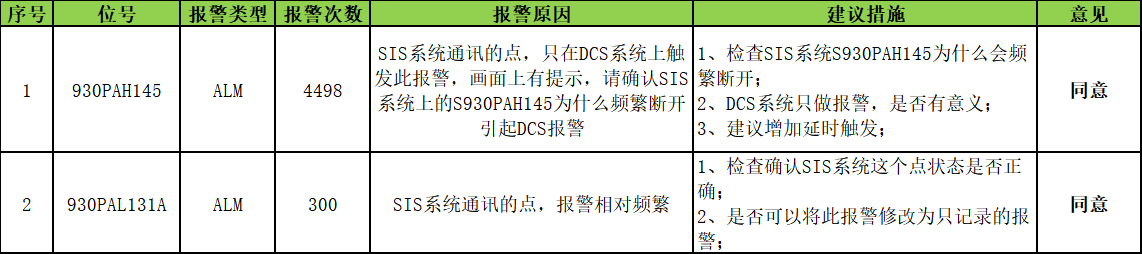
1.2 Transient Flash Alarms
An alarm is classified as a transient flash alarm if it disappears within 10 seconds after being triggered.
Solutions to mitigate transient flash alarms include but are not limited to:
◆ Configure a reasonable dead band range
◆ Add alarm trigger delay (TON) or alarm reset delay (TOF)
◆ Implement PV value filtering
Related Alarms: Similar to repeated alarms, yet they are recurring alarms generated from different tags.
After technical communication with relevant plant staff, specific alarm reduction suggestions are listed as follows (repeated alarms have already been eliminated).

1.3 Duplicate Alarms
Duplicate alarms are divided into static duplicate alarms and dynamic duplicate alarms. The judgment criterion is that two or more alarms activate and clear simultaneously within a ±1-second window. Unreasonable alarm configuration is the main cause of duplicate alarms. Mass redundant alarm notifications distract operators and consume excessive system resources. Optimizing duplicate alarms can significantly improve overall alarm system performance.
Solutions to eliminate duplicate alarms include but are not limited to:
◆ Rational analysis of alarm configurations
◆ Implementation of dynamic alarm management
◆ Adjustment of alarm setpoints
◆ Configuration of combined alarms
Specific reduction measures formulated through technical discussions with relevant plant personnel are listed below:

1.4 Stale Alarms
An alarm is defined as a stale alarm if it remains active continuously for 24 hours after triggering.
Common causes include:
◆ Informational alarms only triggered upon status changes, which do not require persistent alert status
◆ Excessively large original dead band settings
◆ Improper alarm threshold values
Stale alarms provide no valuable information to operators and often fail to reflect actual working conditions. They clutter the alarm list and hinder operators from detecting and responding to new critical alarms. It is recommended to re-evaluate these alarms to determine appropriate alarm configurations.
Specific reduction measures formulated through technical discussions with relevant plant personnel are listed below:

2. Alarm Design Analysis
The formulation of alarm management specifications provides clear principles for alarm design. The alarm design analysis function provided by PSI helps users identify incorrect or unreasonable alarm configurations, so as to fundamentally resolve invalid and faulty alarms. Items such as whether alarm dead bands are configured and whether static duplicate alarms exist can be identified by analyzing alarm configurations.
2.1 Alarm Dead Band
In accordance with the principles and recommended values for analog point alarm dead band settings specified in the alarm management specifications, the dead band configurations within the DCS system are analyzed. The analysis results indicate that most dead band parameters in the DCS adopt the default value of 2%. Such a setting may fail to meet the practical requirements of different technological processes, resulting in some alarms that cannot reset after being triggered.
Dead band configuration shall comply with the guiding principles of the alarm management specifications and be adjusted appropriately based on actual process requirements. The following optimization measures are recommended:

2.2 Alarm Setpoints
Analysis of DCS backup data reveals unreasonable configurations for some alarm setpoints, such as identical values for HH (High-High) and HI (High) alarms. Such improper settings may generate nuisance alarms and cause unnecessary distractions for operators.
To avoid this issue, alarm setpoints shall be configured in line with the guiding principles of the alarm management specifications and adjusted appropriately according to actual process requirements. The following optimization measures are recommended:




